 WHAT'S A GHOST?
 A SPIRIT? They are by definition invisible, intangible, and
can't affect inert matter in any way.
A SOUL? They are by definition invisible, intangible, and
can't affect or inhabit inert matter.
AN ASTRAL BODY (SPIRIT DOUBLE?) They are by definition
invisible, intangible, and can't affect or inhabit inert matter.
ECTOPLASM? Whatever that is, according to spirit mediums, it
can only issue from a human body, and is clearly visible coming
out of the body. It can affect inert matter like an actual limb
of a living being.
A DEMON PRETENDING TO BE A PERSON KNOWN TO BE DEAD?
Shakespeare's Hamlet worried about this possibility, but it is
rarely suggested.
IF A GHOST IS WEARING CLOTHES, are the clothes ghosts of sheep
or of cotton plants? If the clothes are of synthetic fabric, how
can they appear as ghosts when they were never alive?


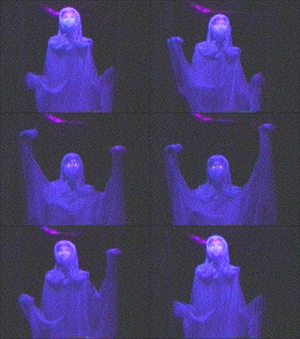
The stereotypical European/American
image of ghosts wearing just a sheet comes from the once fairly
common practice of burying corpses naked, wrapped in a shroud
or sheet.
The very meaning and significance
of the word "ghost"
has changed tremendously over
time. So much so, that on average the word has no real
meaning at present. The ghosts of non-Western cultures are
unrecognizably different from the standard ghosts of US movies
and TV. It is no exaggeration to say that ghosts in the US and
England are entirely a creation
of the media,
like UFOs... indeed, ghosts are a kind of indoor version of a UFO.
Anything perceived as in any way unusual, inside a house, is
declared to be the work of a "ghost," whatever that is.
Also, like UFO abductions, many ghost sightings seem to be vivid
dreams. It should be no surprise then that the history of ghost
photographs is as old as photography itself. The myth
is far more deathless than the ghost itself.


"Ghosts" in non-European cultures
have almost no relation or connection to the standard
representations in US media. For example, Tibetan ghost monsters
include hungry ghosts, malevolent spirits, demons, and wrathful
protector deities, all of which result from a blend of
traditional folklore with Buddhist cosmology, and can manifest
as either harmful monsters or as helpful natural forces
personified. More generally within the traditional belief
systems of most world cultures, ghosts have been used as
supernatural explanations for natural events, especially weather
patterns, storms, forest fires, epidemics, climate changes, and
environmental forces in general. These narratives often
mix local traditional beliefs about death, the spirit world, and
the unpredictability of nature, serving both as cultural
explanations and as coping mechanisms in the face of continual
uncertainty in a hostile natural world. Ghosts more
similar to the modern concept appear in the literature and art
of classical Greece and Rome, and are the root of the modern
ghost mythology.
Instead of looking for ghosts, why
not just
listen? As discovered by Sarah Estep in the 1970s all you
need is a consumer-grade audio recorder. Just record
an empty room and play back at full volume, listen to the noise,
and find patterns. You can hear not only ghosts but also angels
and space aliens, according to her. You can also use video
recordings of non-digital TV channels not occupied by TV
stations. And much, much more. Ghost hunting with
high-tech (and bogus) detection equipment has become almost as
popular as dowsing.
Class web page on ghosts and
poltergeists!
BELIEF IN GHOSTS VERSUS CONFIDENCE
IN SCIENCE
Next