Physics 172
– Recitation 06
Fall 2010
As you work on today’s problems remember that every time you use a fundamental principle you must explain clearly what physical system you are applying the principle to and which objects in the system’s surroundings are interacting significantly with it.
Problem
1.  This
figure shows the positions from 1995 to 2004 of a star, S0-20, that orbits the
center of our galaxy. The orbit is
nearly circular with the radius shown.
For more detail on how the remarkable observations of this star’s position were made and on black holes at the centers of galaxies see 5.P.66 on page 217 of the text.
a) Using the positions and times shown, estimate the star’s speed. Express your answer in MKS units and as a fraction of the speed of light.
b) This is an extraordinarily high speed for a
macroscopic object. Is it, nevertheless,
reasonable to estimate the star’s momentum as  ?
c) Construct a simplified model of the star’s surroundings and use it to estimate the mass of the black hole about which S0-20 is orbiting.
d) How does your estimate of the black hole’s
mass compare to the Sun’s mass,  ? It is thought that
all galaxies may have such a large black hole at their centers, the result of
mass accumulation at a galaxy’s center since the galaxy’s formation.
[Checkpoint 1]
As you solve the next problem, notice that the Energy Principle and the definitions of work and particle energy make it possible to solve problems in new and interesting ways.
Sometimes applying either the Momentum or Energy principle to a system will build equations that you can solve to answer questions about the system in its surroundings. As you will see in this problem, applying one or the other will lead more directly to the answer.
As you gain experience solving problems, you will get better and better at planning simple solutions by choosing to use physics principles in the most efficient ways.
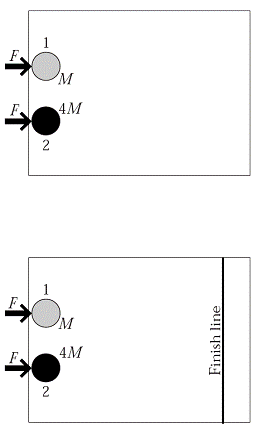
Problem 2.
a) This diagram depicts the initial positions of two disks on a frictionless surface. Disk 2 is four times as massive as disk 1. Starting from rest, the disks are pushed across the surface by two equal forces.
Which disk has the greater kinetic energy after one second? Explain your reasoning.
b) This diagram depicts the initial positions of two disks on a frictionless surface. Disk 2 is four times as massive as disk 1. Starting from rest, the disks are pushed across the surface by two equal forces.
Which disk has the greater kinetic energy when it crosses the finish line? Explain your reasoning.
[Checkpoint 2]
Problem 3. A mass of 0.12 kg hangs, at rest, from a vertical spring in the lab room. At time t = 0 you hit the mass so that begins to move straight downward. The speed of the mass just after you strike it is 3.40 m/s.
a) While the mass moves downward a distance of 0.07 m, how much work is done on the mass by the Earth?
b) If the speed of the mass is 2.85 m/s at that point, estimate how much work was done on the mass by the spring?
[Checkpoint 3]